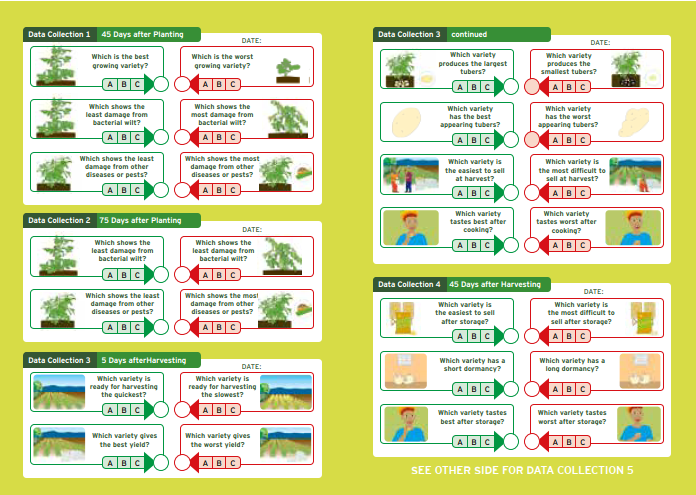
Trial observation
Taken from van Etten et al. (2020), page 21
As the crop grows, the farmers observe the technologies and record their observations on the observation card. For many farmers, the questions asked in tricot pose a new way of looking at things.
Most farmers can tell which of the three technology options they generally like best. But it is not always easy to decide which one is the best for a specific evaluation criterion.
Focus on one criterion at a time
Sometimes it is hard to acknowledge that a technology option was not successful for one criterion, but still performed best for another. For example, imagine a maize variety that was heavily affected by drought and disease and hardly produced yield, but has an excellent growth habit, with many tillers. It could look poor overall but would still be ‘best’ for ‘growth habit’. For best results, it is crucial to really focus on only one criterion at a time and ignore all others.
Choose the right dates for the evaluation
Appropriate timing is important, and farmers should be told at which point in the process each criterion needs to be evaluated. For fertilizers or varieties, it is common to evaluate the trial in three stages: earlier-developing criteria (for example, foliage development), later-developing criteria (for example, disease resistance) and post-harvest criteria (for example, yield or market value). The project implementers should suggest the evaluation steps and dates to the farmers.
Provide follow-up assistance
Many farmers have a busy life and their tricot trial will be one activity among many others. Through telephone calls, the project implementers or the local field agents may help the farmers to keep track of their evaluations and remind them of upcoming observation steps. The telephone calls will also help to clarify open questions and to let farmers know that their contribution is important and valuable. Within their own capacities, the local field agents may also support farmers directly in the evaluation at the plot. These follow-up calls can also be used to support the data compilation if farmers mention that they have already collected their data.
Prepare observation cards
The observation cards contain the questions that participants will answer during their tricot trial about the performance of their assigned technology options. These are always comparison questions, allowing participants to rank their field observations. The questions always follow the same structure, asking for the ‘best’ and the ‘worst’ among the three trial technologies, and should be asked in as few words as possible to make it easier for farmers. For example, instead of asking ‘Which of the three varieties has developed the best foliage?’ the observation card just asks: ‘Best foliage?’.
The questions should be printed on the observation cards that are handed out to participants and should contain images or graphics to guide them. Stock images can be downloaded in the Resources chapter - Supporting material.
How-to make an observation card (two steps):
- Define data collection moments
Decide when participants should make their observations during the trial.
Example: For a bean variety test, you might ask participants to observe at three stages:
- Day of sowing (start of the project)
- 30 days after sowing (mid-point)
- Day of harvest (end of the trial)
- Define observations
Based on the technology options being tested, determine which specific observations participants should make.
Each observation corresponds to one question on the observation card.
Example:
- Plant height → “Which variety grows tallest?”
- Stress tolerance → “Which variety looks healthiest?”